Lucie Pecinová: How to Spark Children’s Interest in Physics? Didactic Games Help
Author: Matyáš Strnad
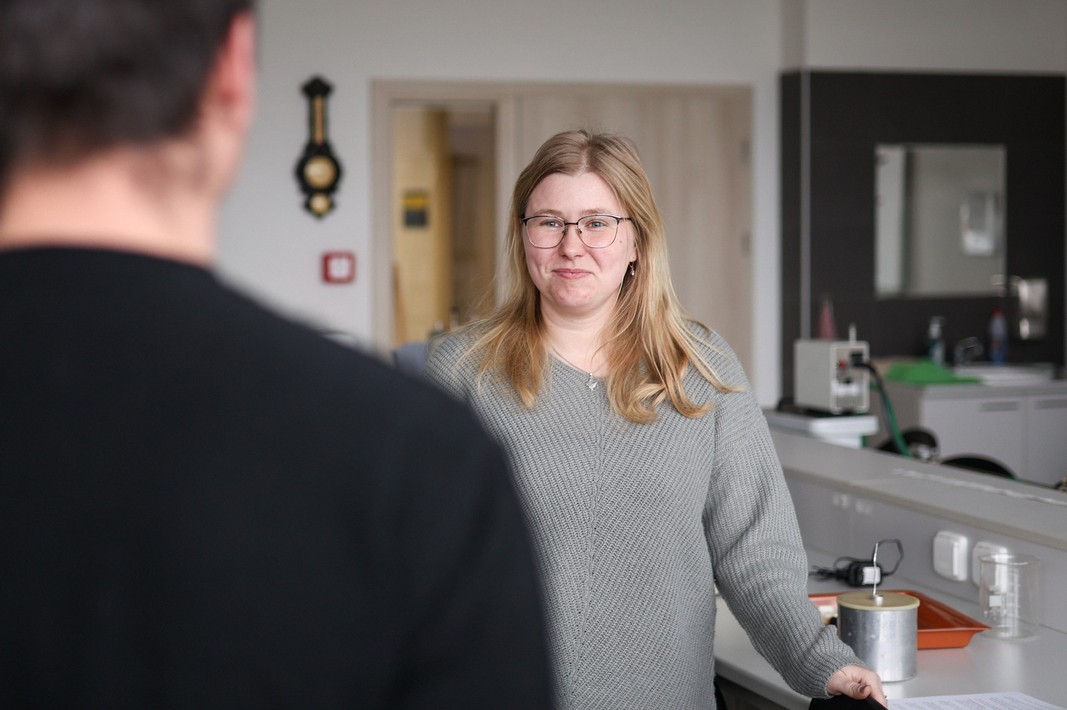
Although she is currently enrolled in a doctoral study programme at the Department of Physics of the Faculty of Science UHK, Lucie Pecinová’s (until recently Habiňáková’s) main job is teaching at a grammar school in Chrudim. There, she tries to engage children, also in physics lessons, through various didactic games. What can educational games look like, and how differently does she approach teaching younger and older pupils?
Studying at UHK and Teaching in Chrudim
As a schoolgirl, she herself was afraid of physics. As is often the case, an enlightened teacher at grammar school helped her overcome that fear.
“I was lucky to have her. She could motivate the whole class, you could see she enjoyed it herself. Thanks to her, the formulas and rules started to make sense,” says Pecinová today, a teacher of physics and mathematics.
“I was drawn to Hradec Králové by the teacher-training programme in mathematics combined with physics. Here I then met Dr. Michaela Křížová, who fundamentally influenced my further direction,” Pecinová describes. Although mathematics was originally her main interest, with Michaela Křížová, she began to take a greater interest specifically in didactic games in physics. They devise some games together and sometimes test each other’s games in their secondary school classes.
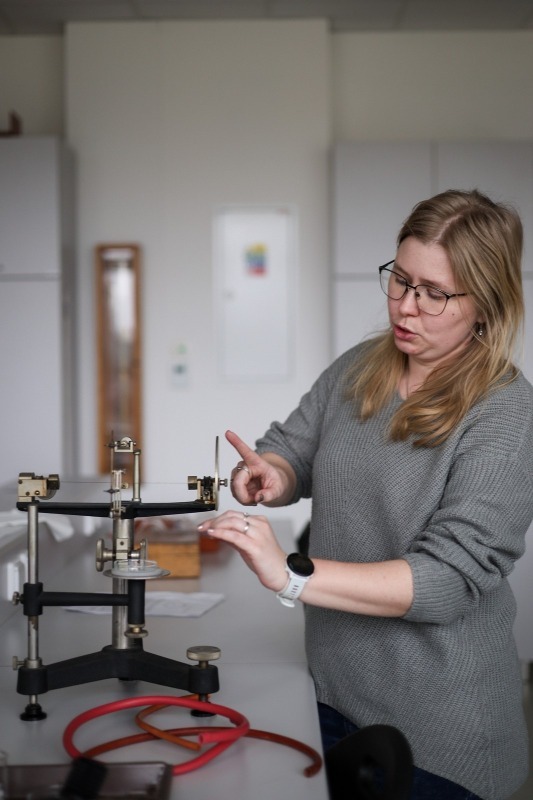
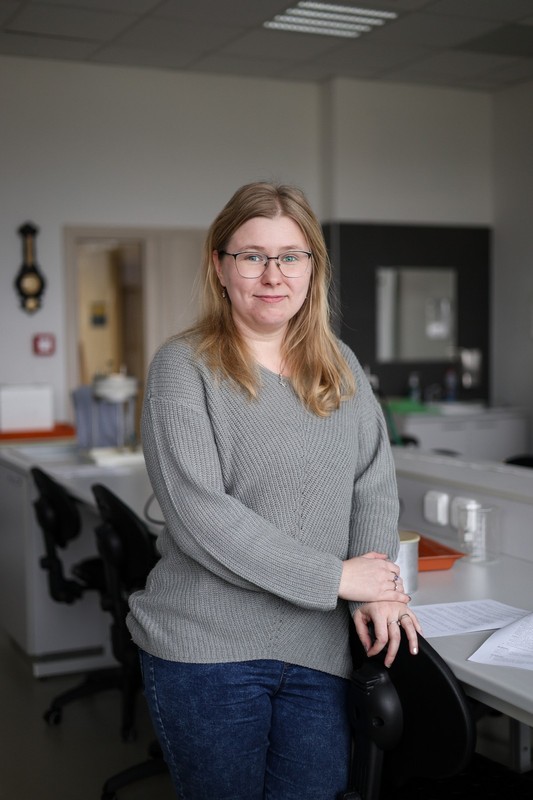
Now Lucie Pecinová teaches at the same grammar school where she once studied. She admits that it is a bit strange to return to the local teaching staff as a colleague. “With some people I switched to first-name terms right away, with others I didn’t. But it’s pleasant mainly because I know those people, and when I don't know something or need advice, I know exactly who to go to. And the people here are really great, besides being excellent teachers.”
At Josef Ressel Grammar School in Chrudim, she also likes the diversity of the individual classes, and although it cannot always be generalized, most pupils are very communicative. “In one class, for example, they are smart but not very hardworking, you really need to intensively supplement teaching with games. Then I have one class where I teach physics, and it's truly golden. They are a bit chatty, but they understand the assignments, do their tasks, and are interested in the material. I even took them to the open laboratories at UHK, which are organized by a colleague, Dr. Jiří Kos.”
An Escape Room for Formulas
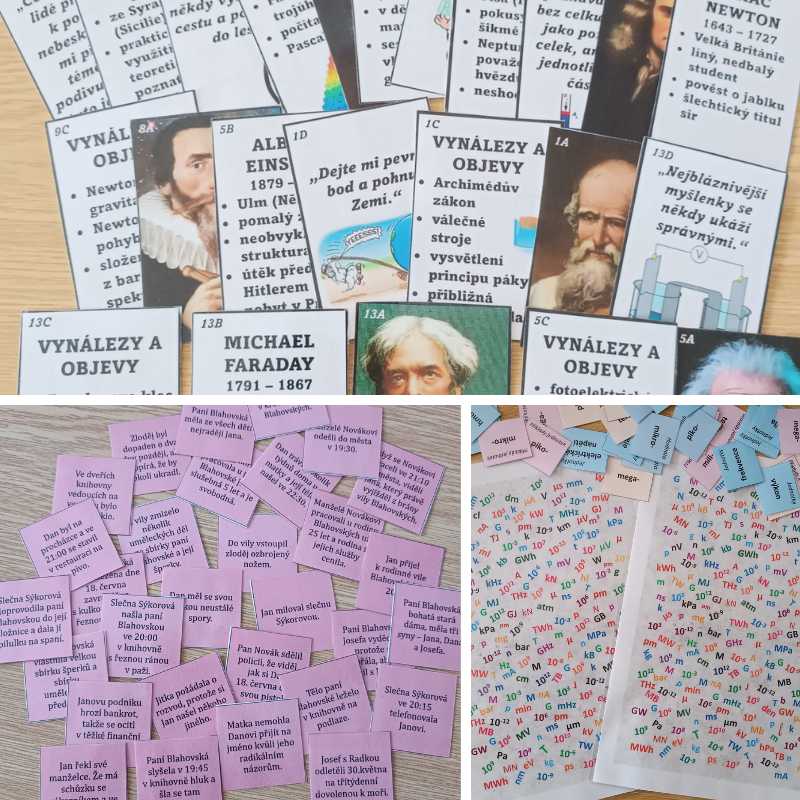
Because Lucie Pecinová specializes in creating educational games, she has at her disposal a whole range of tools that bring physics closer to pupils in a way that feels familiar to them. Recently, she adapted an online escape game.
“It’s actually simple: first, the children look for hidden objects in pictures. When they find them, a task opens up, typically some calculation. If they arrive at the correct result, they get a clue about how to get out of the room where they are ‘trapped’,” she describes. And so, although physics is not the most popular subject among children, similar activities can engage even those who originally had no interest in it.
“I often let them use their own notebooks or textbooks, because some children have trouble navigating even their own notes. This helps them. And when they complain during the game that something is hard and we haven’t learned it yet, I open their notebooks and show them exactly when we covered the topic,” she adds with a smile.
However, this method does not always work: some games, for example, Kahoot quizzes, are too fast. And in general, it is also true that didactic games are time-consuming.
That is, not only their use in lessons, but also their preparation. Although many ready-made materials already exist, teachers' awareness of them is relatively low. And then there are also those who are skeptical about games and have established methods they do not want to change.
“There’s no point in pushing someone into games… Nevertheless, my two colleagues who also teach physics at the grammar school are open to games. When I create something new, I make it freely available. Recently, I played a game with the children in one of my colleague’s lessons. Moreover, some games can also be used in other subjects, such as mathematics, biology, or chemistry.”
Dobble: An excellent example is a stylized Dobble game with physics terms. Thanks to it, children better internalize quantities with correct symbols. For example, they know that there is something like “distance,” but automatically associating it with the letter “s” is not easy. Dobble helps train this more effectively.
Older students in higher grades, on the other hand, sometimes prefer classic frontal teaching with explanation and notes, so that they can prepare for exams where, of course, no games await them.
And thanks to her doctoral studies, Lucie Pecinová also has experience teaching adult students. “I quite often encounter problems with the absolute basics, which people might have mastered better if they had learned through games at lower levels of study. Even the most powerful calculator won’t show you how to rearrange formulas, write a quantity correctly, or use the appropriate term,” she says with a sigh.
Doctoral Studies and Life
Although it is not easy to organize time so that, in addition to teaching at the grammar school and her doctorate at UHK, there is also space left for family and personal life, Lucie Pecinová does not regret her decision to continue studying. It was the aforementioned Dr. Křížová who guided her toward the doctorate, and she still enjoys working with her and creating ever-new ways to enrich the teaching of physics and other subjects.
“Sometimes it’s demanding when you have a full-time teaching job, you’re doing a doctorate, and you commute everywhere. At home, you’re always faced with that ‘third shift’, cooking, cleaning, taking care of things. But I’m very lucky to have a husband who takes over a lot,” she describes.
She also has support from her family in a professional sense: her sister and mother are the first to test new games and can also serve as proofreaders, so that mistakes do not appear in the accompanying materials.
The greatest reward for Lucie Pecinová’s work is active pupils. “Teaching is fun for me. The main thing for me is that children take new knowledge away from my lessons. A nice bonus is when we meet after the holidays in the corridor, and they come up to me and fondly remember our lessons together, when we had fun and learned at the same time,” she concludes with a smile.
Section navigation: Topics