Kateřina Andršová: Music Has a Healing Effect, Relieves Stress, Connects Us. I Am Sorry About the Limitation of Its Teaching
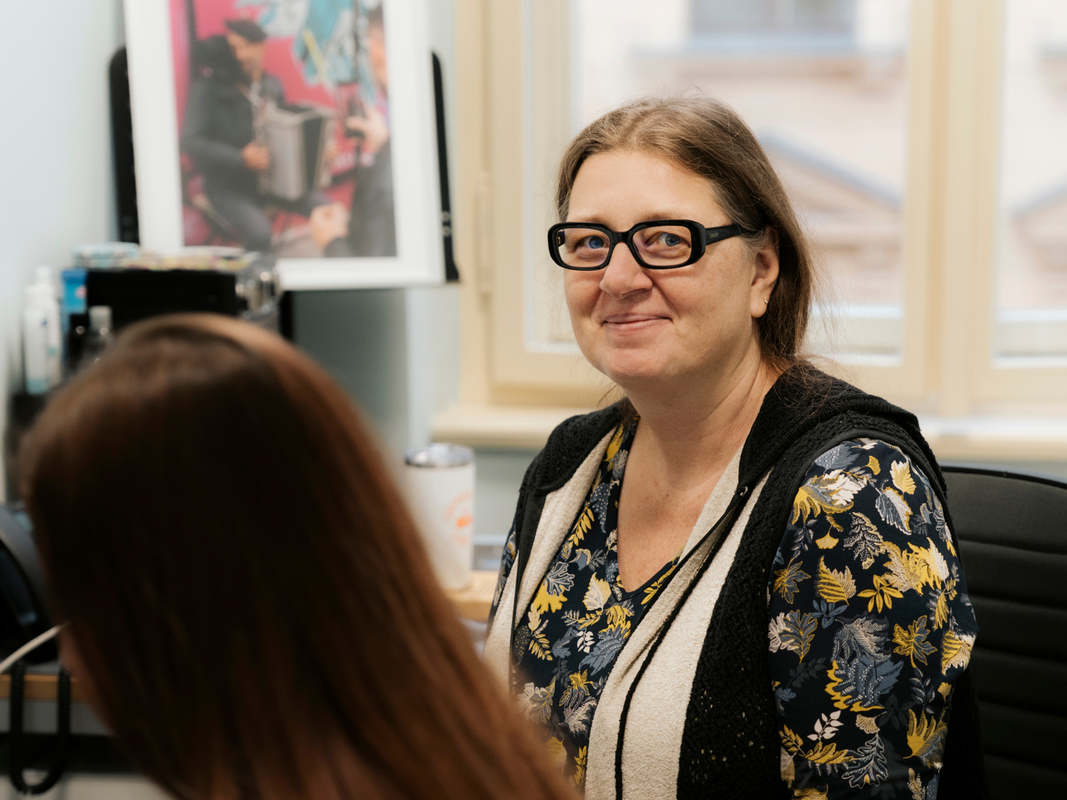
Author: Matyáš Strnad
She professionally focuses on Romani music and culture, which is also a hobby she shares with her husband. She sometimes speaks Romani with her daughter, and when the wider family gets together, they like to make music together. At the Faculty of Education of the University of Hradec Králové, Kateřina Andršová teaches courses in ethnomusicology and coordinates international activities at the Music Department. We talked together about Romani songs, the emergence of the choral tradition in Hradec Králové, and music education in schools.
Kateřina Andršová claims that there are no untalented people and that everyone can learn music. The most difficult situation is for those who cannot perceive rhythm, but even that is not impossible. “My daughter plays several instruments, most often the piano, and when someone tells her that she has a talent from God, she gets angry. And that is because she realizes how many hours she practices every day in order to meet the demands she places on herself,” adds music educator Andršová.
From 2027, the teaching of five artistic subjects at the secondary level in primary schools should be fitted into two hours per week. How do you perceive the future of music education after this reform of the Framework Educational Programmes?
Tragically. A subject that is life-giving, creative, and healing is pushed to the margins simply because there is no CERMAT (high school entrance exams, editor’s note) exam in it. Yet singing, shared musical experience, is an enormous mental relief, especially for children exhausted by sitting all day.
When children “sing themselves out” at the end of the day, they often keep singing in the hallway even after the lesson. Music has a healing effect, reduces stress, and supports social and cultural connections. And 18 minutes a week for music education? What can be learned in that time?
Folk songs are disappearing; children no longer even know “Skákal pes.” Hradec Králové is exceptional thanks to its choirs and elementary art schools, but in small towns and villages, children often never see a live musician playing a classical instrument, such as a violin or a clarinet. In some places, you literally substitute for basic cultural experience; our students also discover this during their teaching practice.
Do you remember the moment when you yourself said, “Music is what I want to devote my life to”?
I actually had it quite easy; I come from a family of musicians. I grew up surrounded by music. My mother played the piano for long hours every day, even though her civil profession was different, she worked as an accountant. Her sister, my aunt, when she looked after us, sang folk songs to us for hours at a time. I grew up in a very stimulating musical environment.
When I much later, at the end of communism, enrolled at the Faculty of Education UHK, we had excellent teachers there. The head of the department was Professor Jiří Skopal; harmony and musical forms were taught by Doctor Berger; music history by Professor Bohadlo. It was Professor Bohadlo who supervised my master’s thesis and later my doctoral dissertation. Thanks to that, I established a close and lasting connection with the Faculty of Education, where I work today.
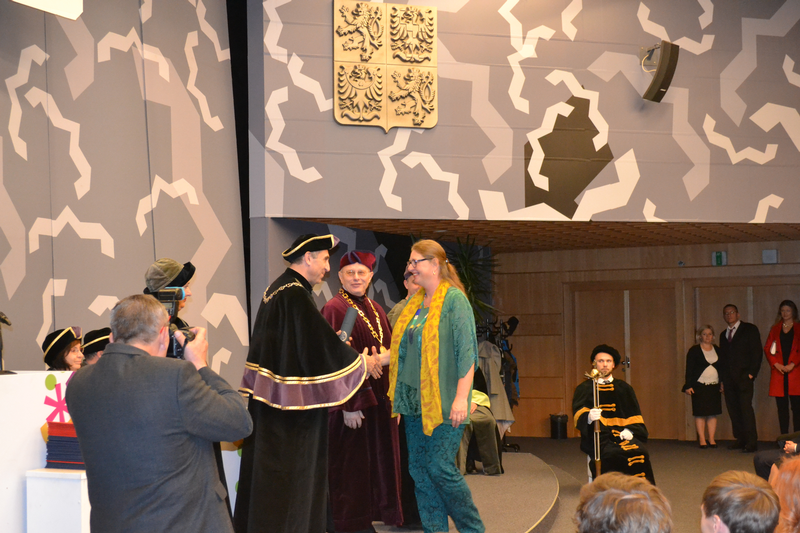
You are used to doing many different activities. Does music and pedagogy permeate or connect everything you do?
That is life. I have been teaching since I was seventeen. I have taught at all levels, from kindergarten to grammar school. I taught for fifteen years at the Music Grammar School in Prague; I led courses in kindergartens and at elementary art schools; now I teach in Ronov nad Doubravou, not only music education, but I have also taught history, civics, English…
Of course, there is a difference between teaching at a Prague music grammar school and at a small rural school, but beautiful things happen there as well. For example, we organized an African concert with children in kindergarten; we invited an African musician, and the children learned African songs, played, sang, and he gave an interactive show. But that was already ten years ago.
In kindergarten, of course, you do not explain what interlocking or pattern thinking is, but children experience it naturally. And that is precisely the beauty, when expertise turns into experience. And that experience then becomes education.
You also engage in publishing and scholarly activities. For example, you researched the work of the world-famous photographer Josef Koudelka. What is little known, and what you highlighted in one of your articles, is that he also recorded Romani music. What did you find out about his recordings?
It was not a publication in the strict sense of the word, but a conference paper for The Gypsy Lore Society, which was published in the journal Romano Džaniben. It was the first processing of a unique collection of recordings that Koudelka made in the 1960s, which is no secret. Koudelka himself tried to persuade various people to do something with those recordings.
My husband has known Koudelka for a long time, and so these recordings came to us, essentially a whole box. It is not a systematic ethnomusicological collection; Koudelka was primarily a photographer, as you mention, but also a musician, he played the bagpipes. Music fascinated him, and so while photographing, he also recorded singing.
What do the recordings themselves look like, or rather, sound like?
They are authentic recordings of Romani singing from Slovak Romani settlements, such as the village of Rakúsy. The recordings have surprisingly good quality; Koudelka had a good sense for working with technology.
It was often the performers’ first experience of hearing their own voices; Koudelka played the recordings back to them, which was shocking and amusing for many. However, only a fragment of the collection has been preserved; part of it was lost.
How do you work with these recordings?
I have transcribed all preserved recordings musically where possible. The problem is that many songs go beyond traditional tuning; they contain micro-intervals and do not intone according to classical scales. Sometimes transcription is impossible for technical reasons as well, for example, when the tape recorder battery was running out.
I am looking for a way to transcribe the songs so that the reader can form an accurate idea of them. I try to find a methodology that captures the harmonic-melodic structure of these songs, because intonation often points to latent harmony related to the region and the singer's musical sensibility.
What type of repertoire appears on these recordings?
It is very diverse. There are traditional Romani songs, songs in Slovak from the folk environment, period popular music, such as Twist Again or Dobrý den, majore Gagarine, migrated songs, because men who worked in Moravia brought, for example, the song Aušvicate hi kher baro, which originates from Moravian Roma, not from the Rakúsy area.
Women, on the other hand, tend to sing songs about family, with deeper local rootedness. All of this reflects the influences of the surrounding culture. Today we have YouTube and streaming services, but back then, communities were more isolated, and music reflected the environment in which they lived.
Is the development of the interpretation of Romani songs evident from this collection?
Definitely. Today, we have a stereotypical idea in our heads of how, for example, Duj, Duj, Dešuduj should sound. But Koudelka’s recordings show that the style of interpretation varied significantly across regions, generations, and environments. One can observe how a musical idiom emerges in relation to the surrounding culture, how a specific aesthetic of singing, rhythm, and phrasing is formed. These are nuances that are often forgotten today.
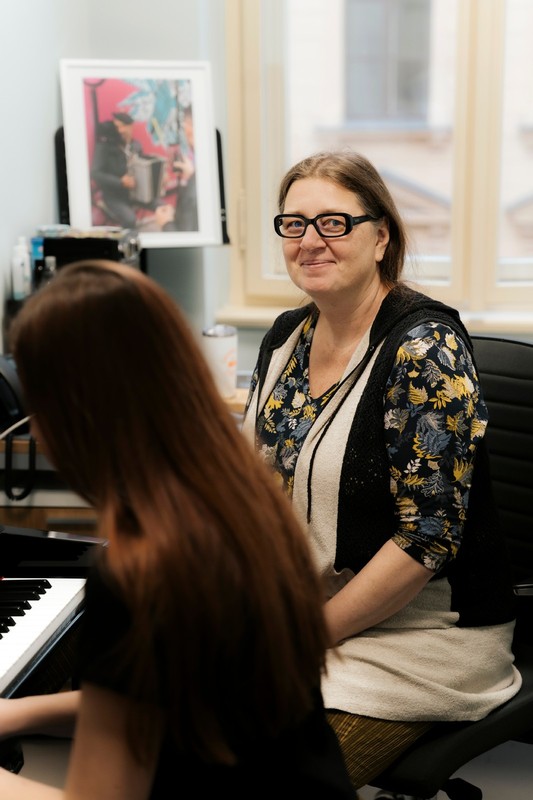
How does the contemporary Romani community respond to your work with historical recordings?
We have many Roma friends who have some idea of what we do. But that they would actively be interested in the scientific side of our work, not really. When we meet, we share music, joy, and time. I do not bring scholarly articles to them. The only person to whom I “slipped” the results of my work was Josef Koudelka, so that he could comment on the content of the study about the recordings he made.
I also processed the songs so that they can be used in a school environment, that is, so that they are singable. This can be interesting, for example, for music teachers.
It is often said that Roma have music “in their blood.” How do you see this?
Music is indeed one of the traditional professions in Romani culture, but that does not mean it is some kind of magical “gift.” It is the environment in which children grow up. In musical families, music is passed on naturally; children hear their relatives play, try it themselves, and practice.
Among Roma, it is also common for them not to read music; they learn by ear. And they often tell you that they have, for example, eight hours of practice a day behind them. Not that they would sit down at a cimbalom and play Liszt’s Hungarian Rhapsody, but they grew up in a musically lively environment where music was played constantly. Father, grandfather, cousin, everyone played. Children thus not only practiced technique, but often accompanied adults to various “gigs,” where they also learned social skills, how to avoid drunk audiences, how to protect themselves and their instruments.
It is a whole complex of skills: musical technique, the ability to react to the environment, empathy, the ability to perceive the band and feel the audience. And that is not something a person gets “from God.” It is the result of years of work, observation, experimentation, and finally, the moment when a master recognizes that his pupil is ready and takes him along to a performance.
When a Romani child learns to play an instrument, do they learn classical school songs like Skákal pes, or a completely different repertoire?
That depends on where the child receives their musical education. If they grow up in a traditional Romani family, Romani songs are of course sung there. Even there, however, there is a certain sequence by difficulty, starting with simpler songs and moving on to more complex ones.
But some families also send their children to elementary art schools. There, they study according to classical curricula and learn the standard repertoire, as in any other music school. An excellent example is a recently published book by Michal Taragoš, in which he describes his path of learning to play the cimbalom under Vlasta Bachtíková, a graduate of the Prague Conservatory. Vlasta Bachtíková played in the ensemble Collegium Flauto Dolce, focused on early music. Michal thus received a classical education; he learned to read music and also played classical compositions. At a competition, for example, he played Vltava by Bedřich Smetana on the cimbalom.
Is the cimbalom, therefore, the “typical” Romani musical instrument?
That is more complicated. The cimbalom, as we imagine it today, is actually a relatively young instrument. Its current form was given to it in the mid-19th century by Václav Schunda, a Czech musical instrument maker from Strašín near Prague. He moved to Budapest, where his uncle owned a musical instrument factory, and there he further developed the cimbalom, a large instrument with pedals. The cimbalom ensemble as a genre is therefore not a tradition several centuries old. The cimbalom is perceived today as a Romani instrument, but it is not some ancient matter. Nevertheless, the cimbalom is amongst the oldest musical instruments, and Romani musicians also played its portable versions in past centuries.
So which instruments were played earlier?
Portable cimbaloms and violins were used. String instruments were common; lavuta is the Romani term for violin, although we do not know exactly whether it was the same instrument as today.
The number of cimbalom players is declining; there are not many teachers or instrument makers, and awareness is lacking. Music is a living organism; it responds to supply and demand. Today, we already have Romani beatboxers or electronic artists. We must perceive music as constantly changing and developing.
In your opinion, can culture and music be used to break down social prejudices?
Yes and no. Prejudices are deeply rooted. When two Czechs meet and do not know what to talk about, they often start discussing their negative experiences with Roma, not in a very correct way.
When someone finds out what I do, they often start telling me their “opinions,” mostly unsolicited. When someone is capable of verbally humiliating another person, the conversation loses value for me, and I have no reason to continue talking to such a person.
So do you try to break down prejudices rather “inconspicuously,” through your work?
Exactly. For example, when we have a summer school at the university for students from Taiwan, I lead a block with them on Czech and Romani music. This year, we sang the Romani anthem Gelem, gelem together. They even managed three-part singing; in Taiwan, music education is at a higher level than here.
For several years, my husband and I worked at the Multicultural Center Prague, within which we co-organized workshops at various schools; we still like the Khamoro festival, but you cannot force anyone to overcome prejudices and get to know something new. Those who want to will find the information. Those who do not will always find someone “weaker” to vent their frustration on.
Do you participate in the Khamoro festival in any way? Could you briefly describe it?
I was not part of the organizing team, but within my work for Czech Radio and the magazine Romano voďi (Romani Soul, editor’s note), I covered the festival from a media perspective. When we lived in Prague, my husband and I conducted interviews with all the performing bands and wrote reports. At the time we did this, the festival was smaller. Today, it is the largest Romani festival in the world and has an extensive media team.
What is the significance of the festival?
Enormous. Khamoro means “little sun,” and it truly brightens the cultural map, not only the Romani one, but also the Czech one. Today, it is an international traveling festival. Concerts take place not only in Prague, but also elsewhere, for example in Hradec Králové.
You spoke about Romani songs, and you mentioned your husband also devotes himself to Romani culture. Do you speak Romani at home?
Yes, we also communicate in Romani at home, including with our daughter, who is actively learning it. This is largely thanks to my husband; he has devoted his whole life to the history and culture of Roma, including Romani music and language etiquette. It is a very rich and interesting topic.
You have also been studying the work of Dobroslav Orel for a long time. Who was he, and why is he important for music pedagogy?
Dobroslav Orel is almost forgotten today, which is a great pity. He was born, incidentally, in Ronov nad Doubravou, my second place of teaching. It was precisely my activities in Ronov nad Doubravou that inspired me to take a deeper interest in Dobroslav Orel. He was a Catholic priest and, at the same time, an exceptional music educator and musicologist. He worked in Hradec Králové from 1894 to 1905, where he founded the first modern boys’ choir. In a very short time, he managed to rehearse demanding choral compositions with students at the realschule (today’s technical secondary school), for example, Ballads by Vítězslav Novák.
His work was not only pedagogical; he also devoted himself to musicology. He was the first to publish transcriptions from the so-called Franus Codex. With his choir, he interpreted Renaissance polyphony, that is, repertoire very demanding in terms of pure intonation and musical understanding.
Orel’s legacy is linked precisely to Hradec Králové, where he laid the foundations of the local choral tradition. This tradition was interrupted after his departure to Prague and later to Slovakia, and I think that contemporary choir conductors are not even aware of this fact.
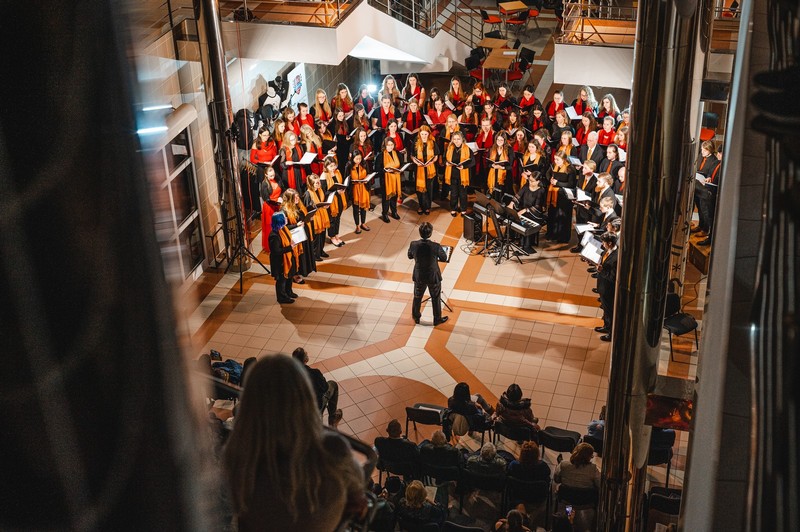
UHK is building strong relations with the American University of Findlay through choral collaboration, partly thanks to you. Do you yourself consider this a significant career success?
I consider the cooperation with the University of Findlay choir to be very significant. My contribution arises from my position, I am the coordinator of internationalization at the Music Department of the Faculty of Education. So every visit within Erasmus, or even outside it, goes through me; I am a kind of link between the international office and our colleagues.
The cooperation with the University of Findlay was born thanks to student Darina Nováková, who studied music education and English. She went to Findlay through the English department, but there she met conductor SeaHwa Jung, who long led the academic choir. Before covid, they tried to find a way to bring the choir to the Czech Republic.
After covid, it finally succeeded. At that time, I had just completed my doctorate and taken over the international cooperation agenda, so I “inherited” this ongoing communication as well. In this cooperation, I act as an intermediary between the American choir and our university choir, which is led by Doctor Skopal.
Will the University of Findlay choir come again?
Yes, they are planning to come again, even in a record number of 57 choristers, at the beginning of March 2026. We are preparing a combined tour; the university choirs will perform together in Hradec Králové and in Prague. Recently, the possibility has opened up for a joint performance of both choirs in Frankfurt am Main, but that is still at the stage of a wish. It is an excellent experience for our students to sing and bond with singers from a different environment.

Mgr. Kateřina Andršová, Ph.D.
Dr. Kateřina Andršová has been working at the Music Department of the Faculty of Education UHK since 2009. At the Faculty of Education UHK, she studied music education and history; at the Music and Dance Faculty of the Academy of Performing Arts in Prague, she completed a four-semester methodological course with certification in piano and singing. In 2019, she earned a PhD in Music Theory and Pedagogy from UHK. She has experience teaching at primary, secondary, and higher education institutions. Professionally, she focuses, among other things, on Romani music and music history. She is married and has a daughter.
Section navigation: Topics