
When the Majority Does Not Rule: Professor Taksu Cheon Lectured at the Faculty of Science
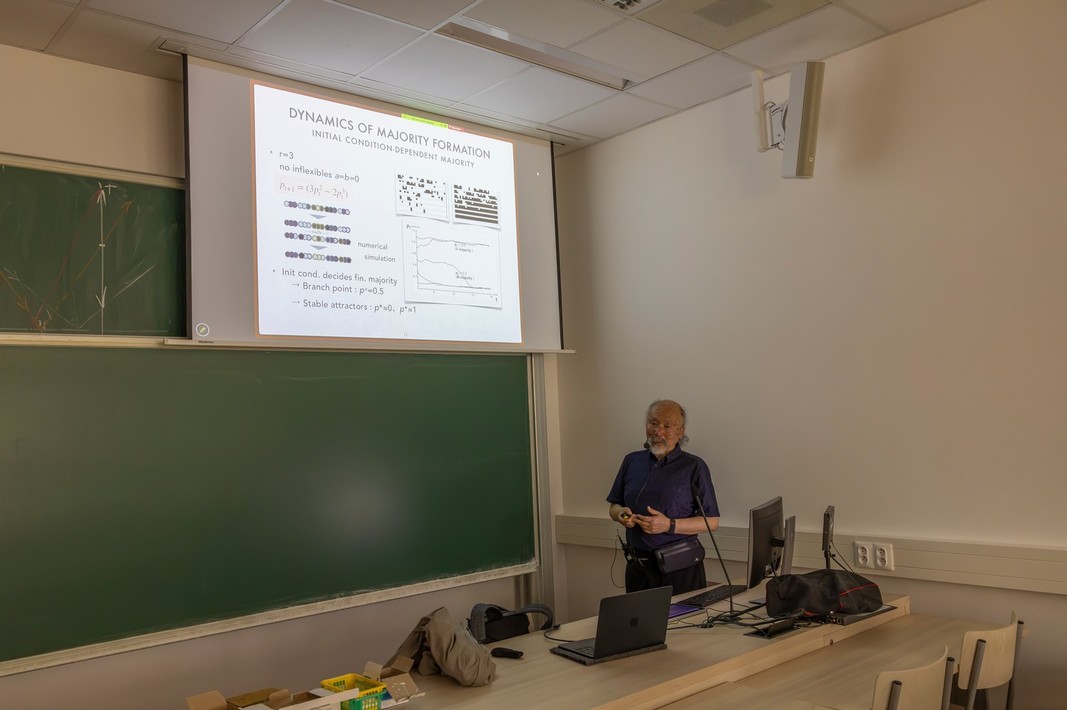
Majority rule may appear to be one of the simplest principles of collective decision-making. Mathematical models, however, reveal that its outcomes can be remarkably complex. During his lecture at the University of Hradec Králové, Professor Taksu Cheon of Kochi University of Technology demonstrated how committed minorities and the distribution of competing opinions can fundamentally affect the outcome ultimately produced by majority rule.
On 2 June 2026, the Faculty of Science UHK welcomed Professor Taksu Cheon from Kochi University of Technology in Japan. His lecture, entitled Some Aspects of Opinion Dynamics, focused on mathematical models that describe how collective decisions develop through repeated interactions within a group.
A central part of the lecture was devoted to the Galam model. It describes a population whose members are repeatedly divided into randomly formed groups and update their opinions according to majority rule. The model distinguishes between “floaters”, who follow the group majority, “inflexibles”, who retain a predetermined position, and “contrarians”, who oppose the prevailing view.
Professor Cheon showed that the final outcome does not necessarily correspond to the opinion initially held by most members of a population. In the two-opinion model with randomly formed groups of three and inflexible agents supporting only one side, a proportion above approximately 17 per cent leads to the automatic dominance of that opinion, regardless of the initial distribution.
The situation becomes even more complex when three opinions compete. In the model discussed during the lecture, two equally large groups of inflexible agents, each representing approximately 13.4 per cent of the population, can prevent a third opinion from prevailing even when it initially has the support of 73 per cent. Professor Cheon also examined how a minority may benefit from a division between larger groups, an effect described in the presentation as “Fisherman’s profit”.
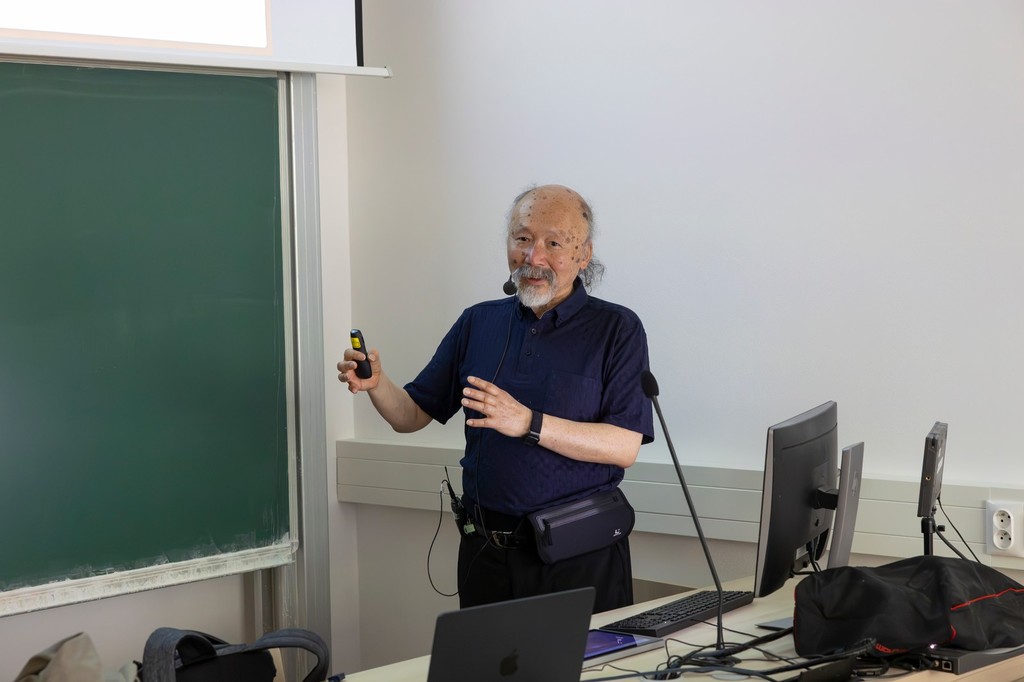
Using equations, fixed points and numerical simulations, he demonstrated how the model changes once certain critical values are crossed. He also explained its connection with models from statistical physics. The two-opinion version is related to the Ising model, while the three-opinion version is related to the Potts model.
The lecture showed how mathematical modelling can reveal counterintuitive mechanisms within majority decision-making. Rather than treating majority rule as an automatically straightforward process, opinion dynamics examines how the composition of a group, the persistence of particular actors and the initial distribution of opinions can shape the collective outcome.
Professor Cheon visited the University of Hradec Králové from 26 May to 4 June 2026 as part of the Erasmus+ International Credit Mobility programme, during which he taught students at the Faculty of Science UHK.